




/Passle/MediaLibrary/Images/2026-01-09-17-39-31-693-69613d531e42b4e613742f2c.jpg)
Bridging the funding gap: the convergence of fund finance and structured finance as a liquidity tool
10 minute read
For limited partners (LPs) fund finance structures offer a way to achieve liquidity for their fund interests, and for general partners (GPs) they provide a means to capitalise their funds.
In a market characterised by slower exits, elongated hold periods and tighter bank balance sheets, and buffeted by not insignificant volatility resulting from current macroeconomic and geopolitical events, asset managers and their lenders are increasingly importing structured finance techniques into traditional fund finance products as they search for innovative and scalable solutions in a sophisticated, capital-efficient way.
Whilst this crossover between fund and structured finance is not new, activity in the space is accelerating as recognition grows of the practical benefits of this convergence. For example, funding channels are broadened by transforming familiar fund finance exposures into securities or derivative-linked cash flows that can be distributed to a wider investor base. In addition, the use of securitisation structuring potentially improves capital efficiency, allowing banks to support larger programmes at lower cost all whilst adhering to regulatory requirements, internal limits and rating-agency constraints.
In this article we unpack the convergence of fund and structured finance that is being witnessed across a range of structures and consider the likely impact of this trend on the availability of liquidity for the remainder of 2026 and beyond.
Where fund finance meets structured finance: emerging trends
1. Application of securitisation techniques to fund finance products
What was once largely theoretical - the idea of applying securitisation techniques to fund finance products - is beginning to be played out in practice via the use of structures such as capital call securitisations, rated note feeder funds, and collateralised fund obligations (CFOs). It is anticipated that this trend will continue as bank lenders look for ways to maintain market share through pricing and/or volume.
Capital call (or subscription line) securitisation: In particular, capital call (or subscription line) facilities (loans secured against uncalled capital commitments of a fund’s LPs, which are repaid using the proceeds from capital calls) demonstrate a set of structural and credit characteristics that lend themselves well to securitisation.
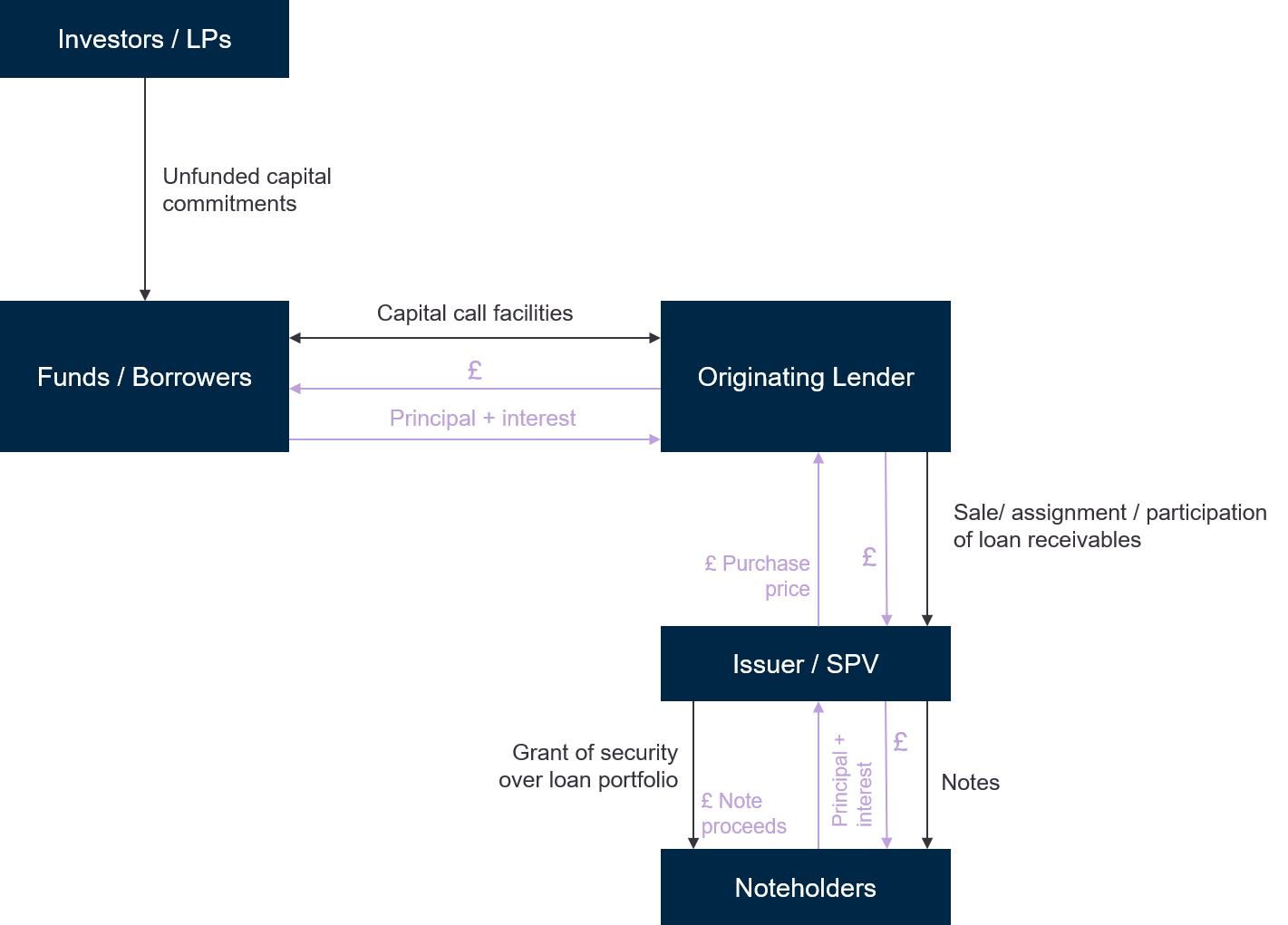
First, a bank that has originated a portfolio of capital call facilities may seek to securitise that portfolio in order to achieve regulatory capital relief, distribute risk, or free up balance sheet capacity. Such a securitisation may be effected on a cash basis, whereby the bank transfers the relevant capital call facilities to an SPV, which in turn issues notes to investors in tranched form. Alternatively, the securitisation may be effected on a synthetic basis, where the bank retains the capital call facilities on its balance sheet but transfers the credit risk to investors through the use of credit derivatives or funded credit protection (such as credit-linked notes), again in tranched form. In either case, the bank achieves a transfer of risk in respect of its capital call facility exposures whilst the underlying fund borrowers continue to draw on and repay their facilities in the ordinary course.
Figure 1: Example structure of a securitised portfolio of capital call (or subscription line) facilities
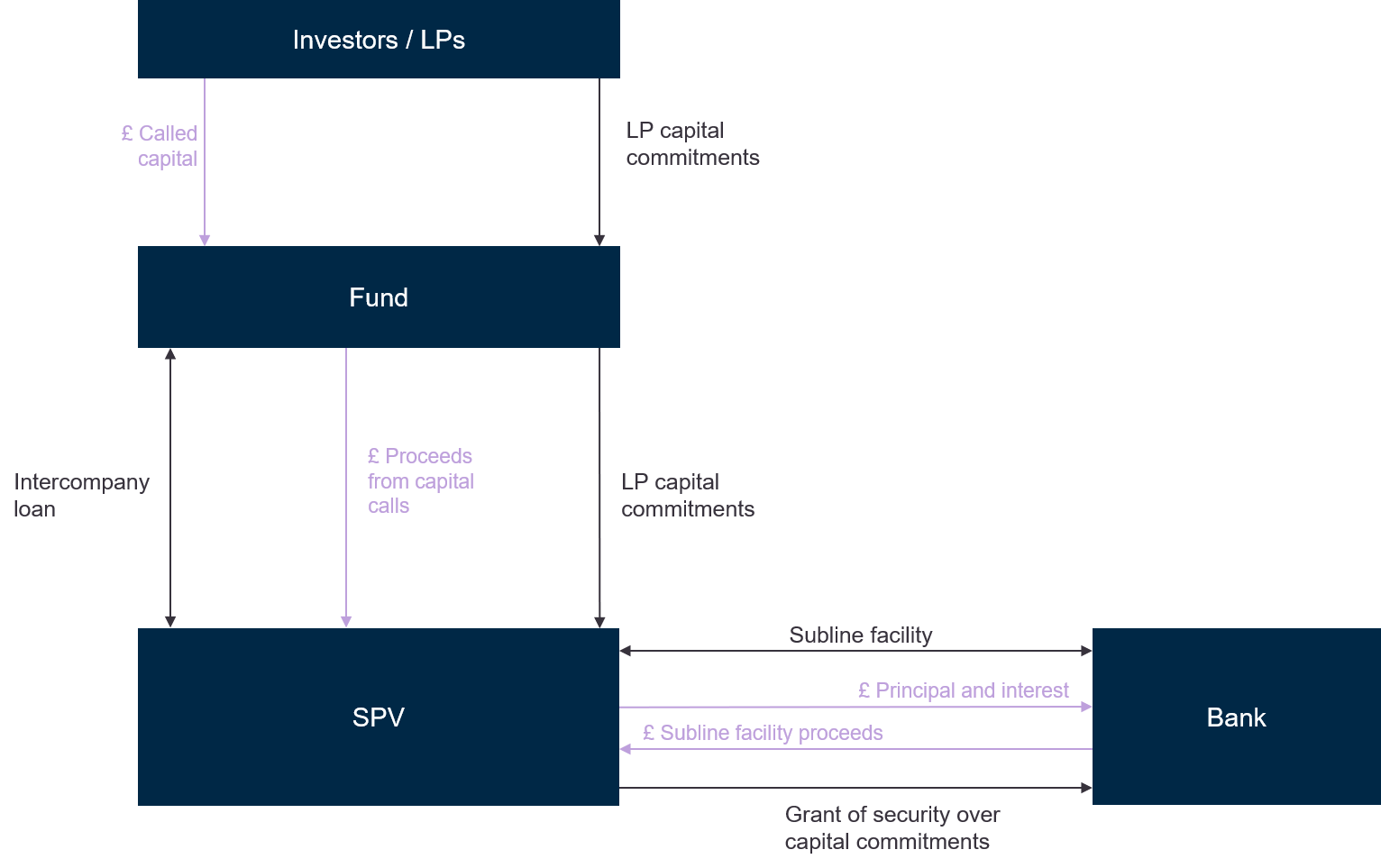
Secondly, a capital call facility may itself be structured in securitisation form. In the most commonly considered such arrangement, the relevant fund transfers its LP capital commitments to an SPV, with payment for those capital commitments effected by way of a (subordinated) intercompany loan. A (senior) subscription line facility is then provided to the SPV (a departure from a standard subline arrangement where the capital call facility is usually advanced to the fund). This achieves the tranching of debt that is necessary for the structure to be classified as a securitisation. The performance of both the senior facility and the intercompany debt is dependent upon the performance of those underlying exposures, thereby satisfying the essential requirement that the credit risk of the securitised exposures be differentiated into tranches with differing levels of subordination. This structure enables the fund to access capital call financing whilst retaining all of the attributes of a more standard capital call line, but in a form that meets the regulatory definition of a securitisation.
Figure 2: Example structure of capital call (or subscription line) facility structured in securitisation form using SPV.
Rated note feeder funds: Sat squarely at the intersection of fund and structured finance, the growing market for rated note feeder funds is largely designed to meet the needs of US and Asian insurers. In light of the popularity of the structure, there is discussion as to whether it can be replicated in the EU/UK under Solvency II/Solvency UK.
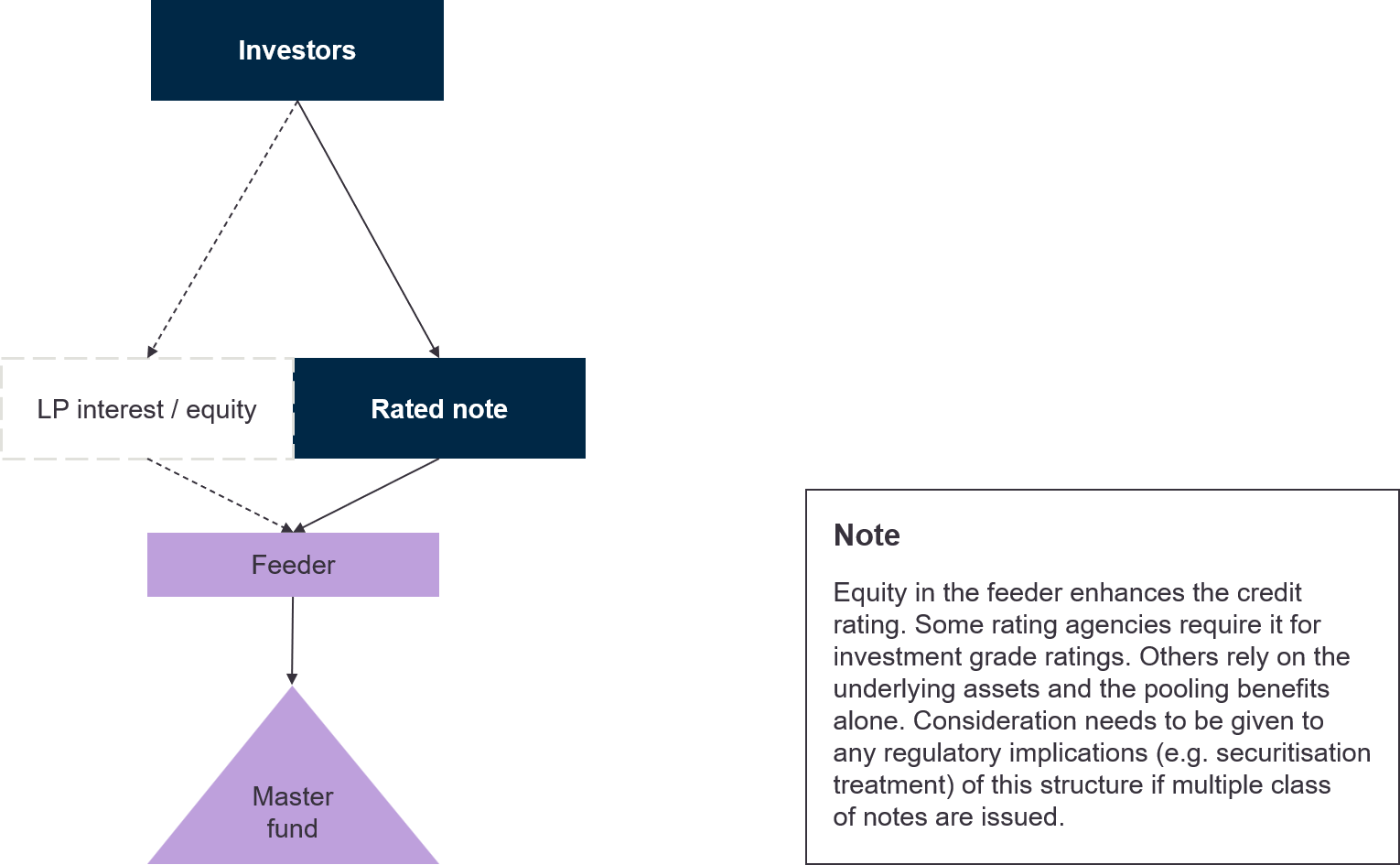
Rated note feeder funds are investment vehicles that borrow tranching, credit enhancement, structural flexibility, external ratings and cash flow waterfall techniques from the securitisation and CLO (collaterised loan obligation) markets. They allow investors (e.g. insurance companies, sovereign wealth funds and pension funds, who typically have specific risk-return requirements or are subject to regulatory constraints) to access private capital through the purchase of rated debt instruments issued by a rated note feeder fund (that can, but need not, be combined with an equity interest). The rated note feeder fund, in turn, invests the proceeds into the main fund alongside traditional equity investors. The notes produce cashflows similar to those from fixed income instruments, and are subject to a lower risk-based capital factor when compared to direct equity investment.
For more on rated note feeder funds, see our article: Rated note feeders: structuring access to private capital.
Figure 3: Example structure of a unitranche rated note feeder fund
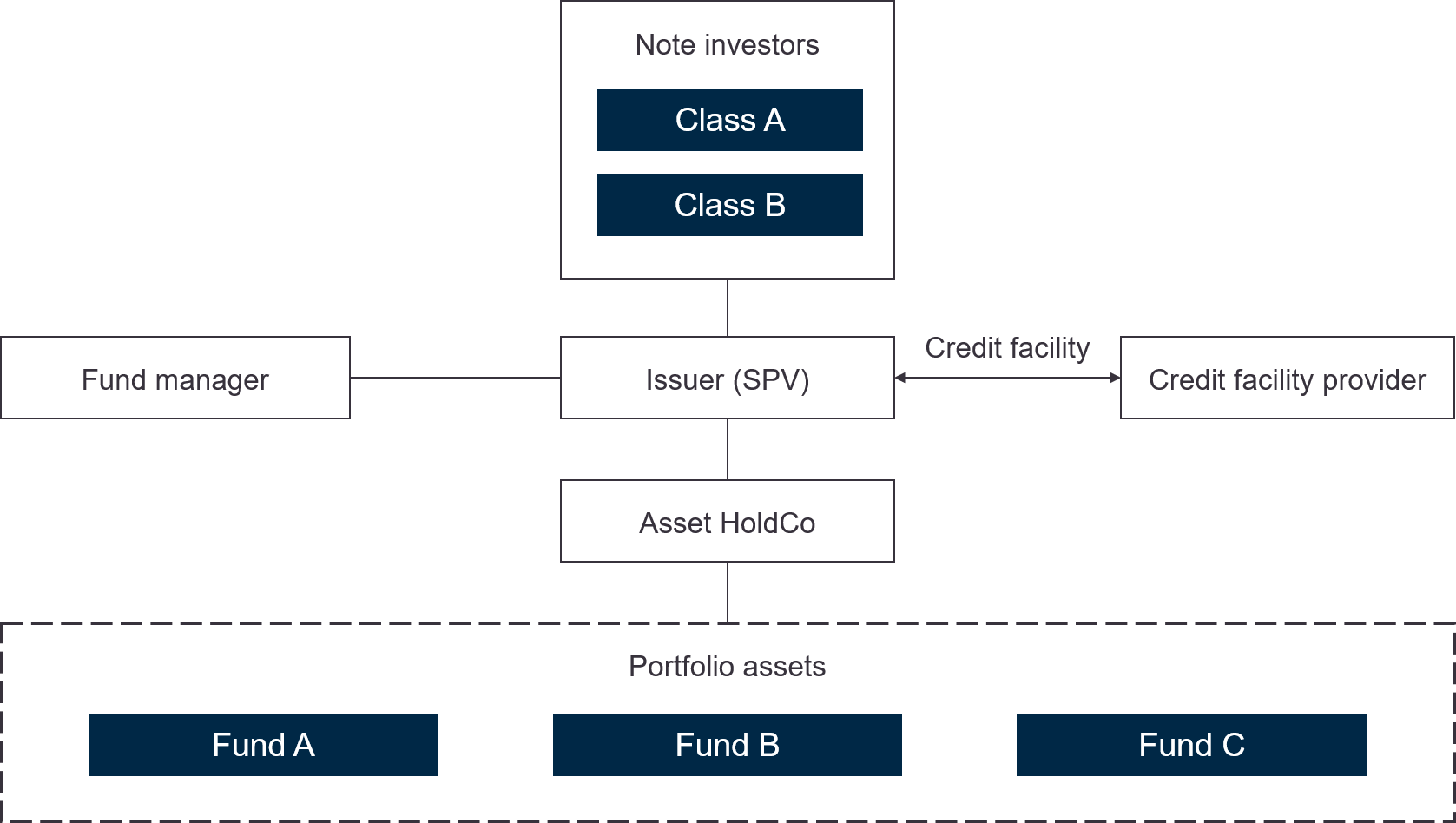
Collateralised fund obligations: Similar to rated note feeder funds, save that the underlying risk is, typically, an investment in a pool of funds rather than in a single fund, CFOs are structured finance instruments that import the core securitisation toolkit (e.g. pooling, tranching, credit enhancement and external ratings) into funds.
CFOs securitise diversified (or potentially more concentrated) portfolios of LP interests in private capital funds (e.g. private equity, private credit, infrastructure and/or real estate funds etc.) and thereby transform them into tranched securities (each with different risk and return profiles) backed by the cash flows and the net asset value of the underlying funds, for sale to a broad range of investors. Sponsors achieve liquidity and leverage against diversified portfolios by allocating risks and returns across senior, mezzanine and equity tranches. Investors access tailor-made exposure to private capital via debt-like instruments.
Much the same as rated note feeder funds, the increasing popularity of CFOs has been driven in large part by an increasing demand from (i) investors seeking rated and capital-efficient access to private capital, and (ii) private capital managers searching for flexible liquidity solutions that are attractive to a more diverse group of investors. In a slow exit environment, CFOs offer a way to unlock liquidity in otherwise illiquid positions without necessitating the sale of underlying assets. For a GP, CFOs can provide a means to meet its commitments to existing LPs. For an existing LP, they offer a way to monetise those of its LP stakes that are no longer attractive to it. We expect to see a continued growth in the use of CFOs in 2026 as private capital sponsors pursue capital efficiency and earlier liquidity.
Figure 4: Example structure of collateralised fund obligations
2. Asset-based arrangements
Traditionally, loans secured by high-quality assets have typically received more favourable capital treatment, and as such banks have long considered asset-based finance less risky than unsecured direct lending. As banks have retrenched from the lending markets in recent years – in part as a consequence of the stricter regulatory capital requirements introduced following the Global Financial Crisis in the late 2000s - an increasing number of private credit fund managers have launched dedicated asset-based strategies to address this opportunity as they look for the next growth opportunity following the maturity of direct lending.
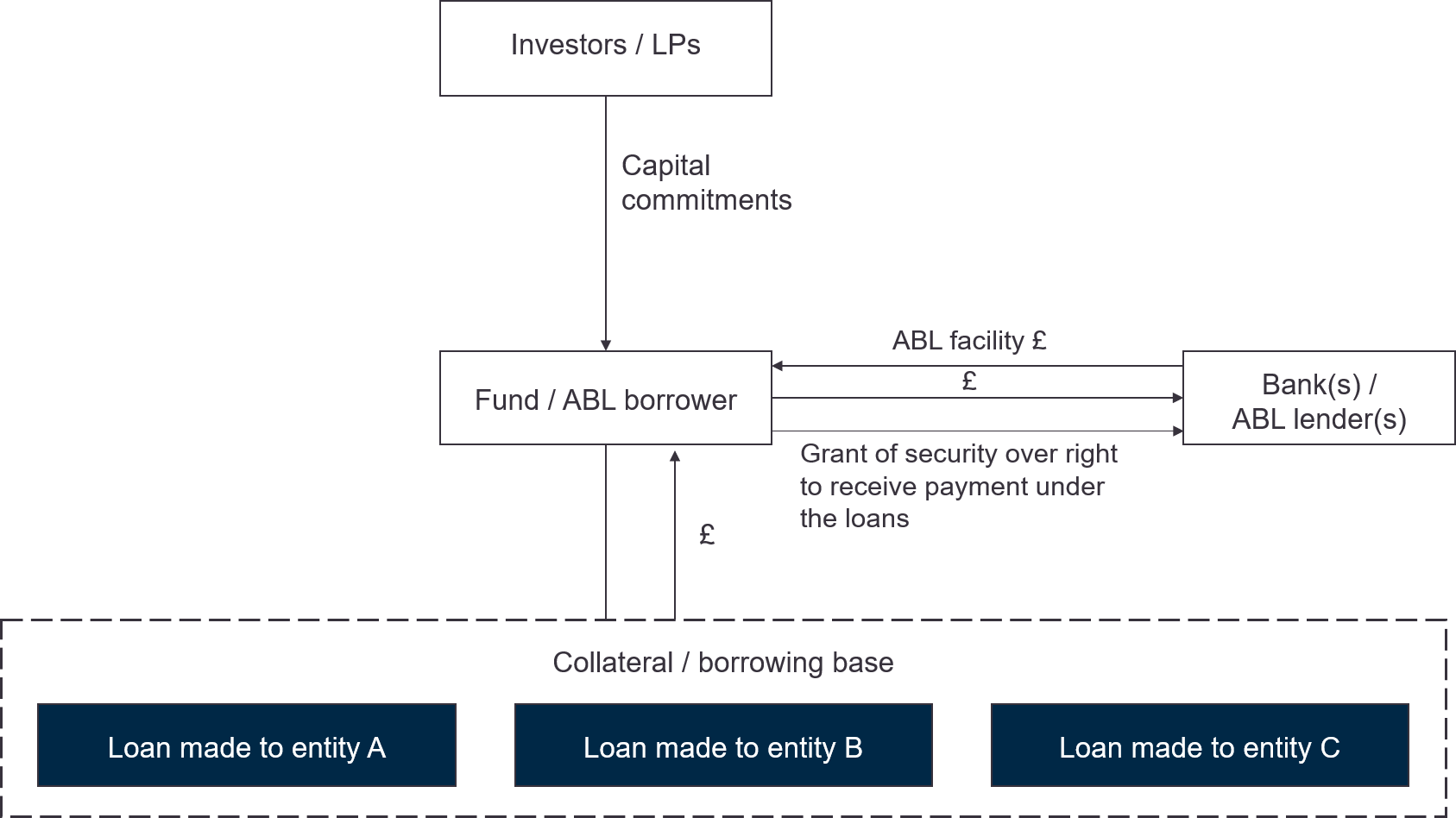
Asset-based lending: Asset-based lending (ABL) is one example of a growing suite of structured products that make use of a fund’s net asset value to obtain leverage.
An ABL facility, in the context of a credit fund, is a secured (usually revolving) credit line where availability is determined by a borrowing base constructed of the loans made by the credit fund. This is distinct from ABL facilities that finance eligible working-capital assets such as trade receivables and inventory.
ABL structures offer a flexible and efficient means of unlocking liquidity from a diverse range of underlying assets (e.g. senior secured loans, speciality finance assets, or receivables), and they can provide liquidity that exceeds cash-flow lending limits in exchange for tighter controls over collateral quality and collections. ABL facilities transpose warehouse, borrowing-base and eligibility mechanics from structured finance (principally CLOs) into fund platforms, enabling scalable, monitored leverage with dynamic advance rates.
One recent evolution and additional driver behind the adoption of ABL is the growing prevalence of evergreen or open-ended fund structures. Unlike closed-ended funds, evergreen vehicles must manage ongoing investor subscriptions and redemptions, which can create significant liquidity management challenges. ABL facilities offer a practical solution by providing ready access to working capital, which can be used not only to meet redemption requests but also to support day-to-day operational needs. This flexibility is particularly valuable in volatile markets, where the timing and scale of investor activity can be unpredictable.
Figure 5: Example structure of an ABL facility
Back leverage: Back leverage - a structured financing technique that enables a private credit fund lender to borrow money from a third-party, such as a bank, to partially finance the loans that they make to borrowers - provides an alternative means of raising fund level finance. As well as increasing a private credit fund's lending capacity, the use of back leverage enhances return on equity and provides a form of liquidity management. ABL facilities (of the type described above) are essentially a form of back leverage but the concept applies to financing for a variety of different investment strategies where the finance provider’s recourse is to the fund’s debt investments. Whilst real estate debt is the most common example, the technique has been applied across direct lending, structured credit, fund finance and other forms of asset backed arrangements.
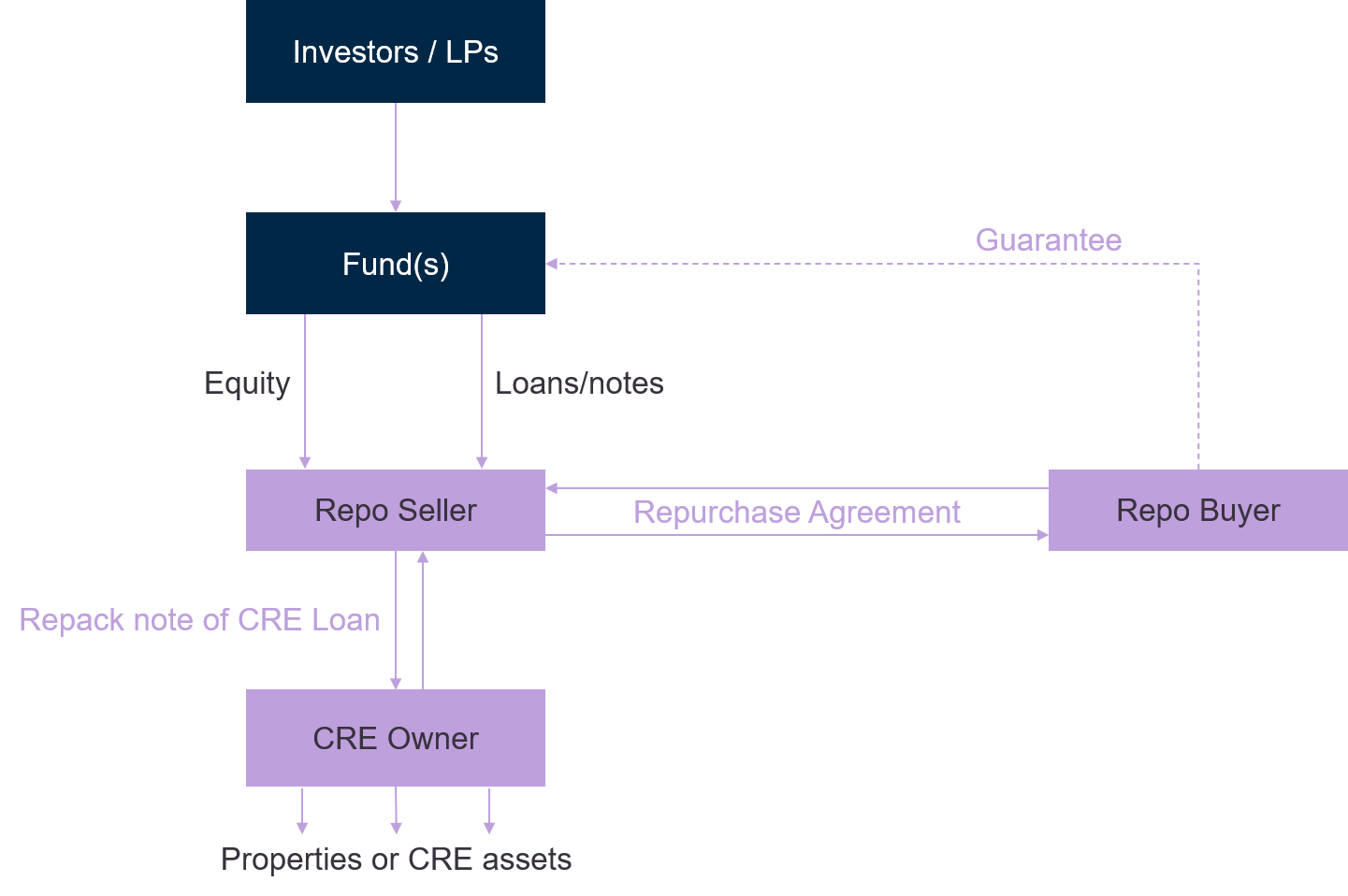
Back leverage can be provided in loan-on-loan format but has often been provided in repo format. Use of the latter was historically prompted by efforts to generate liquidity for what are predominately illiquid debt investments but also has benefits in attracting different investors and accessing different funding lines. In repo back leverage involves a repurchase agreement with the credit fund “borrower” selling securities backed by underlying debt investments to a funder and subsequently buying them back from that funder at a pre-agreed time and at an agreed price. As a result, the borrower receives cash from the funder to redeploy into other lending. Under this type of repo structure, the cash flows from the underlying loan(s) backing the securities are paid on a quarterly basis through the repo structure and may be split between the repo buyer and the repo seller.
For more on back leverage, see our articles: Back leverage a deep dive, and The expanding role of back leverage: "loan on loan" for non-real estate assets.
Figure 6: Example structure of a repo back leverage arrangement
The outlook
There is a clear and accelerating convergence between fund and structured finance. What began as pragmatic borrowing of techniques has matured into a deliberate, systematised toolkit that repackages private capital exposures into scalable, distributable and, in some cases, rating agency compliant formats.
The practical payoff of this shift is twofold: first, debt is increasingly available at a lower cost; and secondly, the investor base is widening to include traditional capital‑markets buyers who prize transparency, cash flow predictability and regulatory capital efficiency. The result of this trend should be measurably greater availability of term and working‑capital liquidity. As the funding stack becomes more elastic, the liquidity outlook for 2026 and beyond is cautiously optimistic.
Authors




Related topics
Like what you are reading?
Stay up to date with our latest insights, events and updates – direct to your inbox.
How can we help you?
Browse our people by name, team or area of focus to find the expert that you need.