




/Passle/MediaLibrary/Images/2026-01-09-17-39-32-113-69613d541e42b4e613742f31.jpg)
Private credit and UK life insurers: structuring for matching adjustment
12 minute read
Over the next decade, an estimated £600bn of assets is expected to move from UK defined benefit pension schemes to insurers, with around £150bn having been transferred in the last three years.
UK defined benefit pension schemes have undergone major transformation in recent years. Improved funding levels have left many schemes fully funded or in surplus for the first time in decades. This presents a historic opportunity to de-risk, resulting in an unprecedented flow of assets into the pension risk transfer market. As these assets and liabilities move to insurers' balance sheets, the rules that apply to them change significantly. Annuities need to be backed by a portfolio of long-dated, liability-matched assets, and insurers are sourcing a growing share of that portfolio from private credit.
Pension risk transfer (PRT): assets transferred to UK insurers (cumulative estimates)

Sources: Approximation based on estimates by PIC1 and LCP 2
In this article, we explore how private credit fits within annuity portfolios, the factors driving recent interest, the structures that facilitate investment, and the challenges managers can expect to encounter.
Key takeaways
|
The role of private credit
Illiquid credit already accounts for over 40% of UK matching adjustment portfolios3. Most of this is secured lending against property and infrastructure, rather than the sponsor-backed corporate lending that people usually mean by "private credit". However, we see clear interest from both insurers and asset managers to expand the opportunity set and gain exposure to a broader range of illiquid credit such as corporate direct lending or asset-based finance.
A point of evidence is the recent run of acquisitions and partnerships between global alternative asset managers and UK insurers. In March 2026, Apollo-backed Athora completed its acquisition of Pension Insurance Corporation and announced plans to relocate its group headquarters to the UK4. Brookfield acquired Just Group for £2.4bn in 2025, merging in its existing UK insurance platform, Blumont5. Blackstone, rather than acquiring an insurer outright, agreed a private credit partnership with Legal & General worth up to $20bn6. Most recently, Standard Life announced the launch of its UK Pension Risk Transfer Partnership with CVC, Prudential Financial Inc, Goldman Sachs and MS&AD, which will allow Standard Life to have access to private markets asset origination including direct lending, asset-backed lending, and structured credit7. Each of these gives the manager involved a route into a UK annuity balance sheet, either through ownership or a dedicated origination mandate.
The regulatory drivers: highly predictable cash flows, sub-investment grade cliff and Matching Adjustment Investment Accelerator
Since Brexit, the Prudential Regulation Authority (PRA) has been rebuilding Solvency II into a UK-specific regime, Solvency UK. The Treasury has been explicit that one objective is more insurance investment in infrastructure and other illiquid, productive UK assets, which lines up with the Government's wider pensions and growth agenda.
The matching adjustment is a mechanism available under Solvency UK that allows life insurers to discount their liabilities at a rate closer to the actual credit-adjusted yield on those assets (rather than the standard risk-free rate), after stripping out an allowance for credit risk. It can be applied where insurers are holding bonds or similar assets to maturity and closely matching the cash flows on those assets to their annuity books.
Two key changes to the matching adjustment rules took effect in 2024.
1. The allowance of up to 10% of an insurer's matching adjustment benefit to come from "highly predictable" cash flows rather than strictly fixed ones, covering instruments with features such as prepayment options or deferral rights that previously sat outside MA eligibility8.

2. The removal of the “sub-investment-grade cliff”, which previously meant that a downgrade below BBB could disproportionately reduce an insurer’s MA benefit. This makes insurers more comfortable holding lower investment-grade credit, rather than encouraging investment in sub-investment-grade assets.
The Matching Adjustment Investment Accelerator (MAIA), introduced in October 2025, also allows insurers with existing MA permissions to add eligible assets and claim the benefit immediately, subject to a cap, before obtaining formal approval within 24 months9. Complex or uncertain cases must still follow the standard process, but MAIA may indirectly accelerate these by freeing PRA capacity.
Take-up of the highly predictable bucket has been slower than the reform itself. While some insurers have already used it, most have not, though more progress is expected later this year. In any case, most managers currently designing products for this market are targeting the larger fixed cash flow bucket rather than the highly predictable one.
Why does matching adjustment matter to insurers?
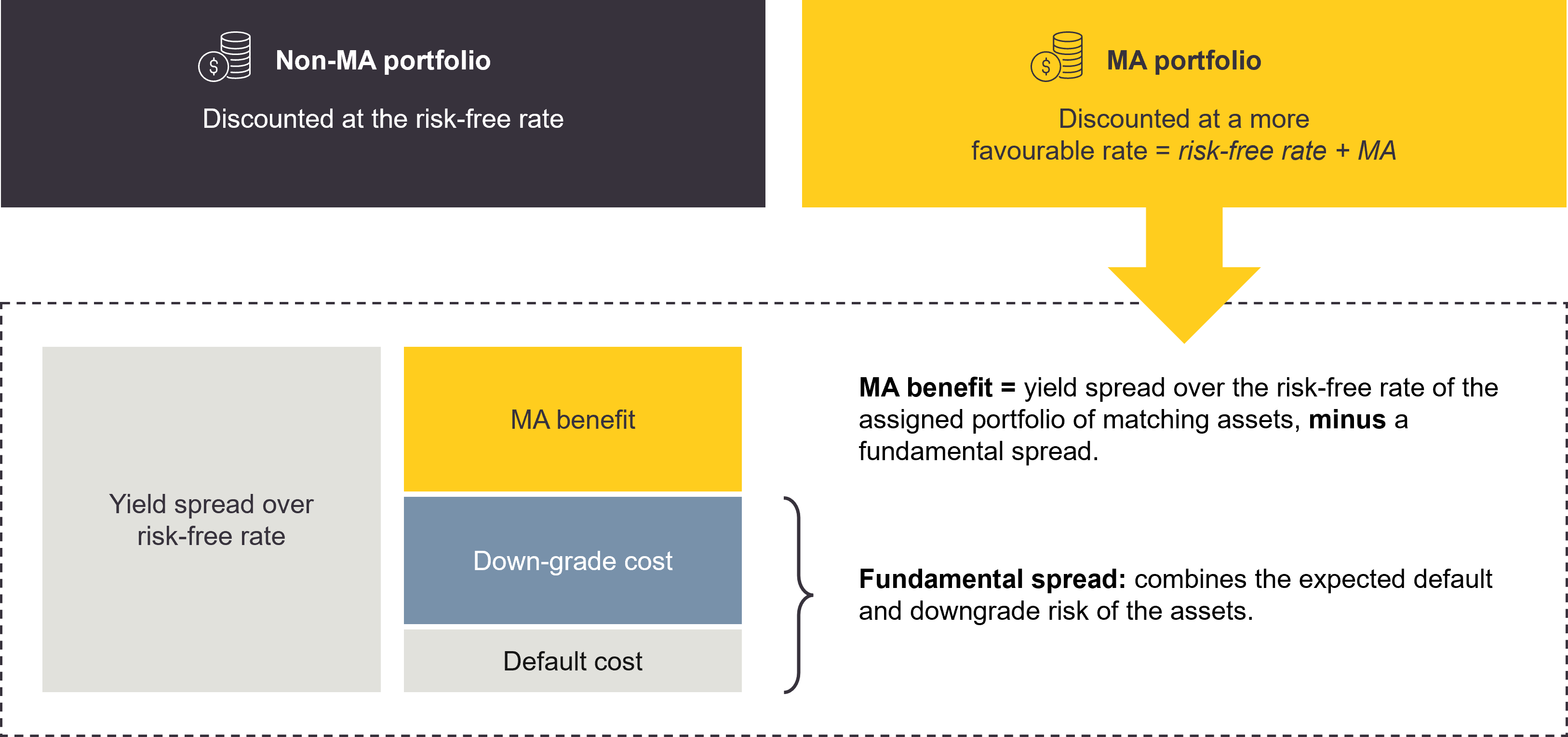
The matching adjustment benefit is an additional discount factor applied to the calculation of liabilities. The matching adjustment itself is the yield spread on the matching portfolio over the risk-free rate, minus a fundamental spread which considers the cost of default and downgrade on those assets. In practical terms, the effect of a higher discount rate is that the present value of the insurer's liabilities comes down, which reduces its technical provisions and frees up capital. So, matching adjustment really delivers its benefit in two ways: it reduces capital requirements and it boosts available capital resources.
In summary, the matching adjustment benefit is larger where, for example: (i) the yield spread is higher for the same credit rating; (ii) where the rating is better for the same yield spread; or (iii) where the liability runs for longer, because the discount rate benefit compounds over more years.
A matching adjustment (MA) portfolio must be ringfenced
1. Impact on capital efficiency
The effect of a larger matching adjustment is that the insurer needs to hold a lower amount of assets today to match against liabilities. A higher discount rate produces a lower present value of the liability - its best estimate liability (BEL) – and a lower BEL means a lower amount of assets is needed to back an identical set of promised payments to policyholders.
The figure below illustrates this effect. For an illustrative £1bn, 10-year liability, a public single-A bond produces a 37bps matching adjustment, reducing the BEL by c.£35m. If a private debt issuance earning an additional 100bps increases the matching adjustment to 137bps, the BEL is further reduced by £122m.
Illustrative impact of the Matching Adjustment on a £1bn portfolio
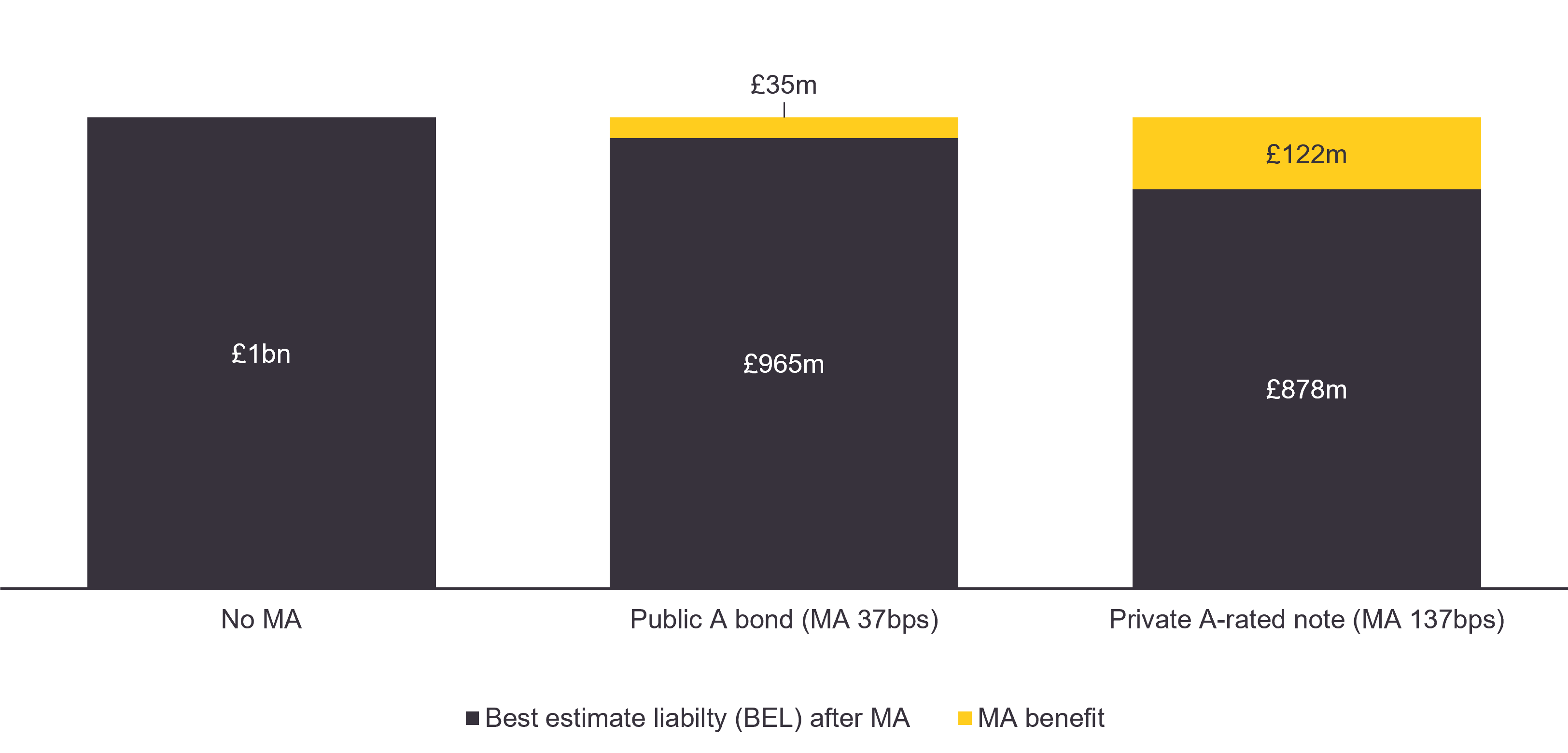
Note: Illustrative only. The private debt issuance is assumed to have fixed contractual cash flows and the same single-A credit risk characteristics as the public market comparator, with no additional fundamental spread. In practice any additional fundamental spread would reduce the MA benefit shown.
Source: Macfarlanes analysis based on PRA SS7/18 and Solvency UK technical information (31 July 2026); S&P iBoxx GBP Corporate data (31 July 2026).
This example assumes the insurer concludes that the private debt issuance's additional spread reflects credit risk already captured in its single-A rating, rather than some other risk that would call for a higher fundamental spread. Where the additional spread available in private markets represents illiquidity, origination or structuring premium rather than additional retained credit risk, a substantial proportion of that spread may translate into additional matching adjustment benefit. In practice, that is a judgement for the insurer, and ultimately the PRA, to reach on the specific asset, not an automatic result of sitting in this category.
2. Impact on pricing
In a bulk annuity transaction, the insurer is quoting the premium it requires to take on responsibility for members' pension benefits – usually funded from the scheme's pension assets. A smaller liability means a smaller premium is needed to accept the same benefits, so an insurer with a larger matching adjustment can quote a lower premium than a competitor with a smaller one. The same pricing dynamic plays out in all annuity transactions beyond pension risk transfer, for example in the individual annuity market.
Who is in the UK PRT market and how can managers get access?
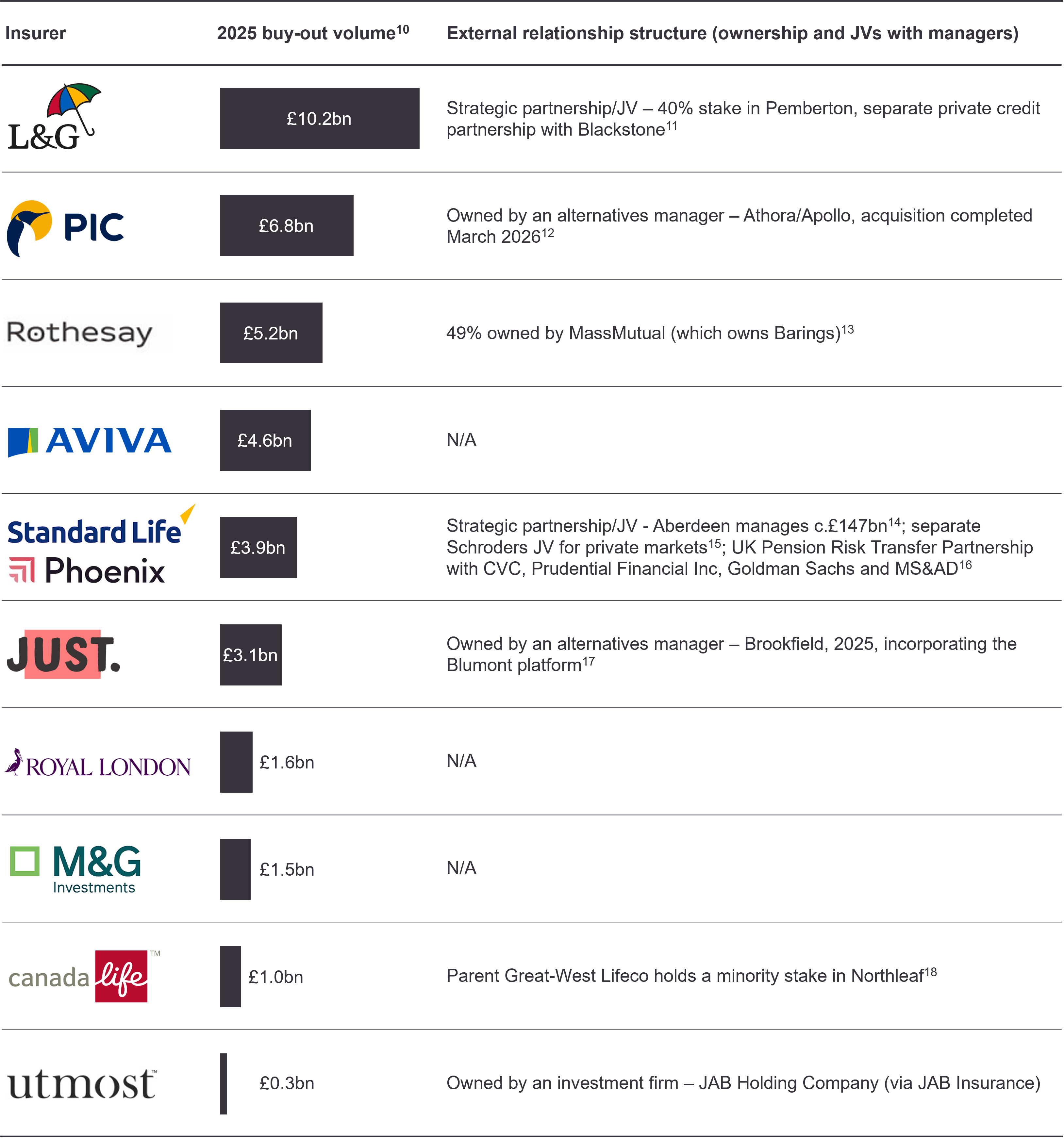
Ten insurers are currently active in the UK PRT market. Beyond size, addressability must also take into account an insurer’s in-house alternatives capabilities and its existing tie-ups with other managers, including through ownership structures or joint ventures.
What this means for managers
The insurers active in this market look to deploy capital at scale, so a single partnership, once established, can carry significant volume over time. The constraint in this market is usually the supply of matching-adjustment-eligible assets. As such, there are opportunities for external independent managers even where insurers have in-house capabilities and/or tie-ups with external managers. Recent partnerships between Standard Life and CVC or L&G and Blackstone, illustrate how insurers are looking to complement their existing capabilities with managers offering additional private-market origination.
A manager's prospects depend mainly on two aspects: whether the assets it originates can be structured to meet matching adjustment requirements, and whether its strategy is additive to an insurer’s existing origination capabilities.
Structuring private credit for matching adjustment
Private credit and structured credit have been converging for several years, most notably in the asset-backed finance (ABF) strategy. One important driver has been demand from insurers for debt instruments that fit their liability profiles. This is also evident in the UK life insurance market, where managers and insurers are seeking to transform private credit exposures into investment-grade structured instruments that qualify for the matching adjustment.
Typical private credit features, such as floating rates and prepayment optionality, do not directly meet MA requirements. Assets must be bonds or have similar cash-flow characteristics; their cash flows must be fixed or qualify as highly predictable; the portfolio’s cash flows must replicate the liability cash flows in the same currency; and the assets must generally be held to maturity. Structuring can help close this gap.
Exposure through structured products
Two approaches account for most of what is being built in this market.
Private debt CLO
Places a portfolio of loans into a special purpose vehicle (SPV) and tranches it into a senior note that qualifies for MA and junior and equity notes that do not. CLOs use well-established technology and provide considerable scope for credit enhancement, but fall within the EU Securitisation Regulation and UK Securitisation Framework, which brings higher standard formula capital charges, risk retention requirements and additional reporting. This option may become more attractive for EU insurers from 2027, when changes to Solvency II will reduce standard-formula capital charges for senior securitisation tranches, including non-simple transparent standardised (STS) securitisations. Private securitisations would, in most cases, be considered non-STS. The PRA has not so far proposed an equivalent recalibration for UK insurers under Solvency UK, although the UK securitisation framework is itself currently undergoing reform.
Rated note feeder
A feeder invests in, typically, an underlying private credit fund and issues rated notes alongside a subordinated equity or limited partner (LP) interest. The notes can be structured to qualify for the MA, while the subordinated interest is non-MA. It may be structured to avoid securitisation treatment, however, it offers less scope for credit enhancement than a CLO. An evergreen or other long-dated underlying fund can also help support the duration required by insurers.
For more information on rated note feeders, read this article and watch a snippet from our webinar on this topic.
Although this remains a nascent area of product development, we have seen several structures developed for this market – across both options described. One public example is the Ares private debt CLO built specifically to fit MA portfolios in June 2025, with Legal & General as cornerstone investor.
Another emerging trend is the use of insurance guarantees, whereby all or part of a note is wrapped by an insurance policy guaranteeing payment. By bringing the credit strength of the insurer into the structure, the guarantee can enhance the credit profile, and therefore the rating, of the note. This can make the instrument more attractive for inclusion in a matching adjustment portfolio.
Exposure through fund finance
A less visible route is through fund financing. Insurers can provide term loans to funds that originate subscription-line and other fund-finance assets. Short-dated loans may offer additional spread over comparable public-market instruments. However, their short duration limits their usefulness for matching long-dated annuity liabilities. Longer-dated fund-level loans can provide a better duration match if structured with fixed contractual payments, appropriate prepayment protection and covenants such as overcollateralisation and diversification tests.
Key challenges for managers
- Cash flow modelling: for cash flows to be considered fixed or even highly predictable this may require a considerable excess spread. The difference between the collateral income and the interest paid must be sufficient to maintain stability requirements whilst simultaneously still having enough yield (after fees) to make the product attractive.
- Placing the equity: while some investors may be happy to take a vertical slice of a structure, others only look for horizontal tranches meaning it is up to the manager to source the equity. For managers without large balance sheets this can be challenging, particularly in less standardised structures such as rated note feeders.
- PRA approval: all MA portfolios, and therefore their investments, require PRA approval. Managers benefit from working closely with experienced insurers when developing new products to ensure they are indeed eligible.
How Macfarlanes can helpMacfarlanes combines deep expertise across private credit, structured finance and insurance. We have advised insurers and asset managers on structuring a wide range of assets to meet matching adjustment requirements, as well as on other insurance-related structures. To discuss any of the issues raised in this article, or how a particular strategy might be adapted for the UK insurance market, please contact a member of the team. |
Endnotes
- PIC, "PIC warns parts of England could become unviable without urgent action on flood resilience" (2026).
- LCP, "LCP's predictions for the pension risk transfer market in 2026" (2026).
- Gareth Truran, "Innovation and resilience in the BPA sector" (speech, Bank of England, April 2026).
- Athora Group, "Athora Group completes acquisition of Pension Insurance Corporation Group and announces plans to relocate headquarters to the UK" (2026).
- IPE, "Just Group to be acquired by Brookfield Wealth Solutions in £2.4bn deal" (2025).
- Legal & General/Blackstone, "L&G and Blackstone announce strategic partnership to accelerate growth ambitions" (2025).
- Standard Life, "Launch of UK Pension Risk Transfer Partnership" (2026).
- An asset has to be classified wholly as fixed or wholly as highly predictable; insurers cannot split a single instrument's cash flow between the two buckets.
- Subject to a cap of the lower of 5% of best estimate liabilities or £2bn per firm.
- Transaction volume as reported by LCP – "Record number of buy-ins in 2025, with the busiest H2 ever as competition intensifies" (2026).
- Blackstone, "L&G and Blackstone announce strategic partnership to accelerate growth ambitions" (2025).
- Athora Group, "Athora Group completes acquisition of Pension Insurance Corporation Group and announces plans to relocate headquarters to the UK" (2026).
- Rothesay, "Our investors" (2026).
- Standard Life Aberdeen/Phoenix Group, "Strategic partnership between Standard Life Aberdeen and Phoenix Group Holdings" (2021).
- Standard Life, "Standard Life to launch next generation private markets default strategy" (2025).
- Standard Life, "Launch of UK Pension Risk Transfer Partnership" (2026).
- Brookfield Wealth Solutions, "Brookfield Wealth Solutions announces Just shareholder approval of acquisition" (2025).
- Mackenzie Investments/Great-West Lifeco/Northleaf Capital Partners, "Mackenzie Investments, Great-West Lifeco and Northleaf Capital Partners close transaction" (2020).
Authors


Related topics
Like what you are reading?
Stay up to date with our latest insights, events and updates – direct to your inbox.
How can we help you?
Browse our people by name, team or area of focus to find the expert that you need.