




Finland pension reform: implications for private markets
8 minute read
On 1 July 2026, the first phase of Finland’s pension reform took effect, easing solvency rules for the country’s private-sector pension insurers and giving them materially greater capacity to take investment risk. As established investors in private markets, these insurers could present further fundraising opportunities for international managers as the reform is fully implemented.
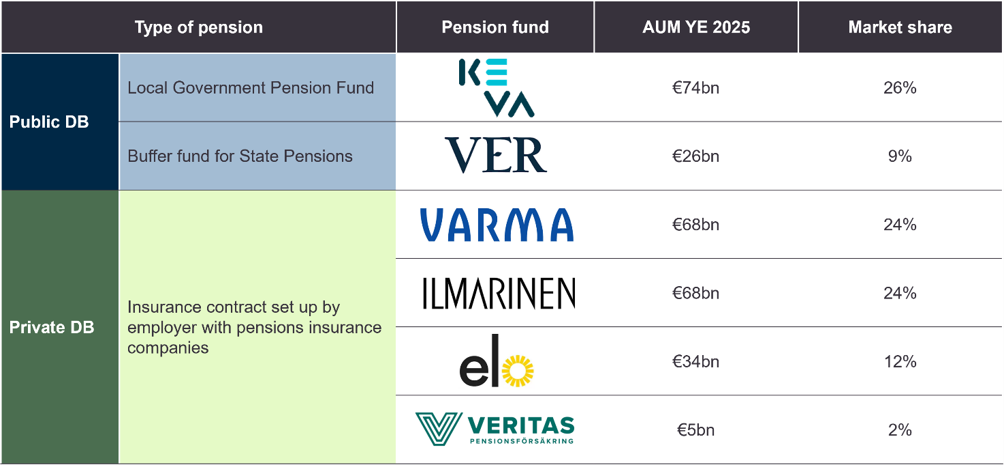
Finland’s occupational pension system holds approximately €285bn in assets under management.1 Four private-sector pension insurers – Varma, Ilmarinen, Elo and Veritas – manage over 60% of that capital and are the principal institutions affected by the investment-rule changes. Public-sector investors Keva and VER, which account for most of the remaining assets, operate under different regulatory regimes.
Finland has one of Europe's most concentrated private pension markets – the four providers account for over 95% of private-sector pension assets. Unlike its Nordic neighbours, where occupational pension provision has increasingly shifted towards defined contribution (DC) arrangements, Finland retains a predominantly defined benefit (DB) system. Its partially funded pension system supports a long-term investment approach, with Finnish pension insurers maintaining substantial allocations to private equity and other alternative assets.
Figure 1 – Finland’s pension assets are concentrated among six leading providers
Source: Companies' annual reports, Finnish Pension Alliance (TELA).
In this article, we summarise the reform, look at how pension providers are responding and where the additional risk capacity could create opportunities for private markets fundraising.
Risk capacity rises
Finland’s statutory occupational pension system is governed by a domestic solvency framework that is inspired by Solvency II. Similarly to Solvency II, the framework does not set specific allocation limits, but instead it requires capital reserves to be held based on the risk of their investments. The framework also incorporates collective risk-sharing mechanisms based on the average investment risk taken on by pension insurance companies collectively. The previous rules were found to encourage herd behaviour and to be misaligned with pension insurers' long-term investment horizons. The reform aims to correct these issues by giving pension insurance companies greater capacity to take on investment risk.
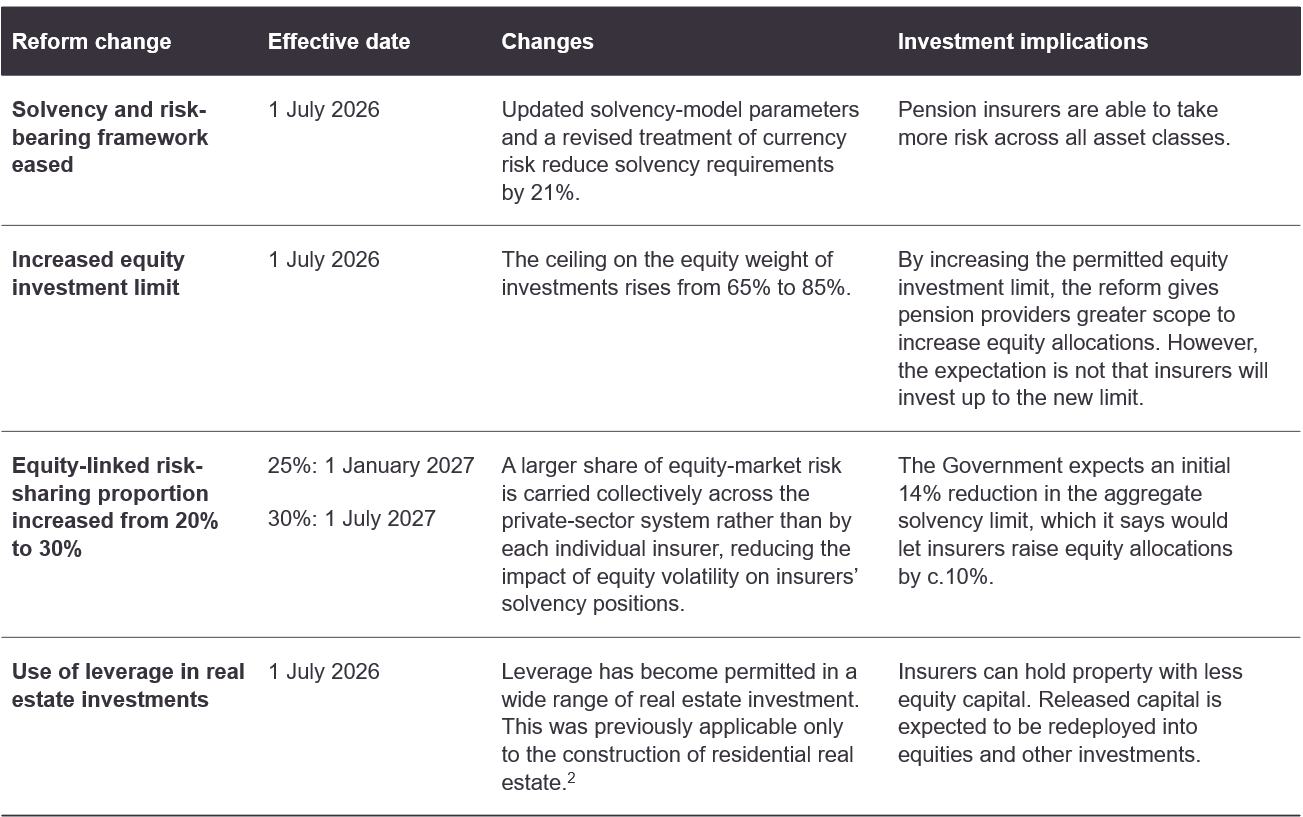
The combined reduction in the solvency limit is estimated to be c.35% in aggregate – 21% through the easing of solvency requirements and 14% through the increase in risk-sharing between providers.
Understanding risk sharing
For a specified portion of an insurer’s pension liabilities, the effect of equity returns is shared across all private-sector providers rather than falling entirely on that insurer. That portion was previously set at 20% and will rise to 30% by July 2027. When equity markets fall, an individual insurer’s solvency is therefore less affected, so it needs to hold less capital against equity risk and can hold more equities while maintaining the same solvency position. The trade-off is greater interdependence, as providers are collectively responsible for the system and must support one another if one fails.
Figure 2 – Key changes under Finland’s 2026 pension reform
Source: Macfarlanes’ analysis of Finnish Government publications, FIN-FSA calculations and Finnish Pension Alliance (TELA) publications.
Impact on private equity
Private equity is among the private asset classes expected to benefit from the reforms, with pension providers gaining greater flexibility to increase allocations to both public and private markets.
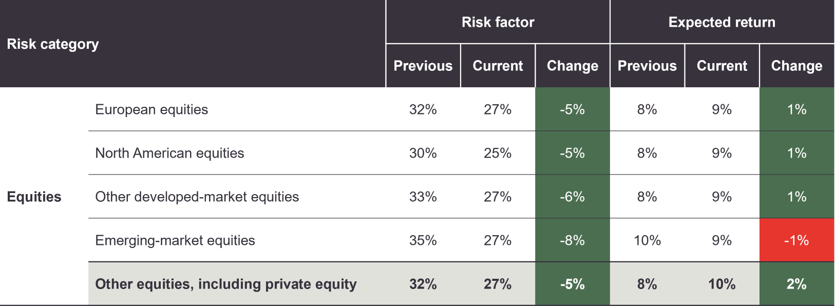
The Finnish solvency capital requirement is calculated by combining assumed rates of return, risk weights and a correlation matrix, all set out in the Government Decree. Both the expected returns and the risk factors have been updated in the recent reform – private equity saw a 2% increase in its expected return and a 5% reduction in its risk factor.
Importantly, the reforms recognised the greater return potential of private over listed equities, which was previously not reflected in the solvency model.
Figure 3 – Changes to solvency risk parameters relevant to private equity
Source: Macfarlanes’ analysis of Finnish Government publications.
While the reforms create scope for equity exposure of up to 85%, pension insurers are not expected to approach this ceiling. Ahead of the reform, expectations pointed to an increase of c.10–15%, much of which has already materialised, with all four pension insurers increasing their equity exposure ahead of and following implementation of the reform. The next stages of the reform may support further increases, as the equity-linked risk-sharing proportion rises, with government estimates suggesting that equity allocations could exceed 70%.3 This would place Finland above many other defined benefit pension investors, including US public pension funds (averaging 56% in equities)4 and UK private-sector DB schemes open to new members (averaging 42%).5
Finland’s higher equity exposure partly reflects the structure of its pension system. Unlike in fully funded pension schemes, only a portion of future pension obligations is funded through investments, with the rest financed on a pay-as-you-go basis. This, combined with collective risk-sharing, allows the system to absorb greater investment volatility. The reform builds on this by enabling pension insurers to take more risk while reducing the likelihood of forced asset sales during market downturns.
Figure 4 – Finnish pension insurers have already increased equity exposure
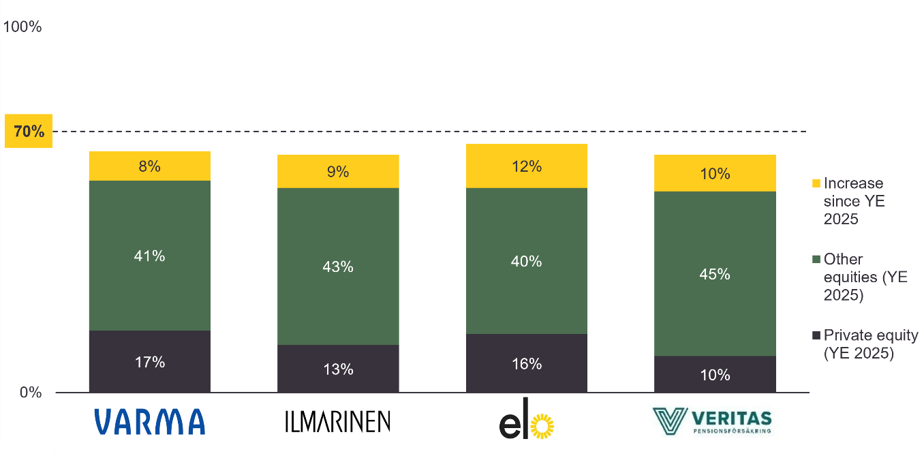
Note: Equity allocations reflect total equity exposure, including exposure through derivative contracts.
Source: Companies' reports and press releases.
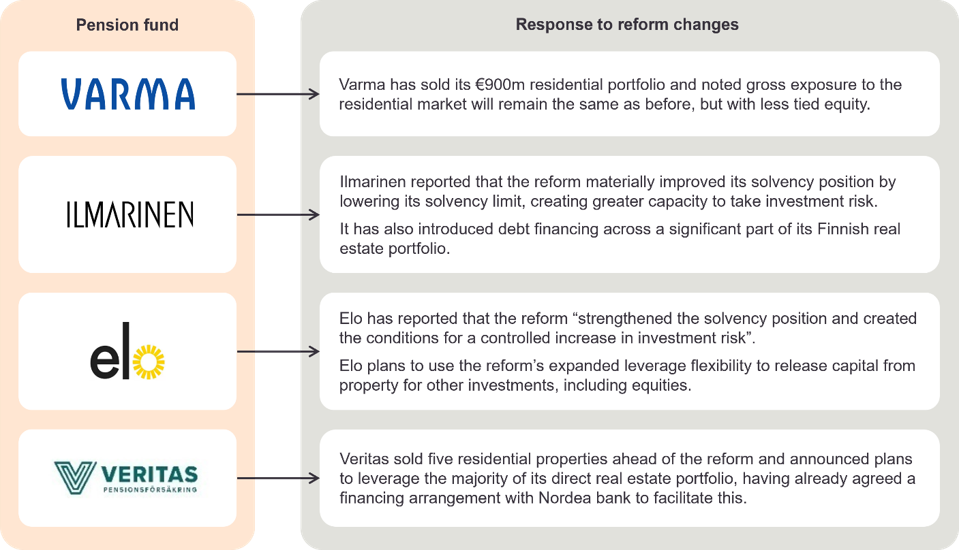
The early response to the reforms suggests a broader shift in how Finnish pension insurers manage their portfolios. Alongside increasing equity exposure, pension insurers are seeking to release capital from existing real estate investments through asset disposals and greater use of leverage. This points to a more active approach to capital allocation, with the reforms creating opportunities to redeploy capital towards higher-return investments, including private markets.
Figure 5 – Early responses to Finland's pension reform
Source: Companies' reports and press releases.
Impact on private debt
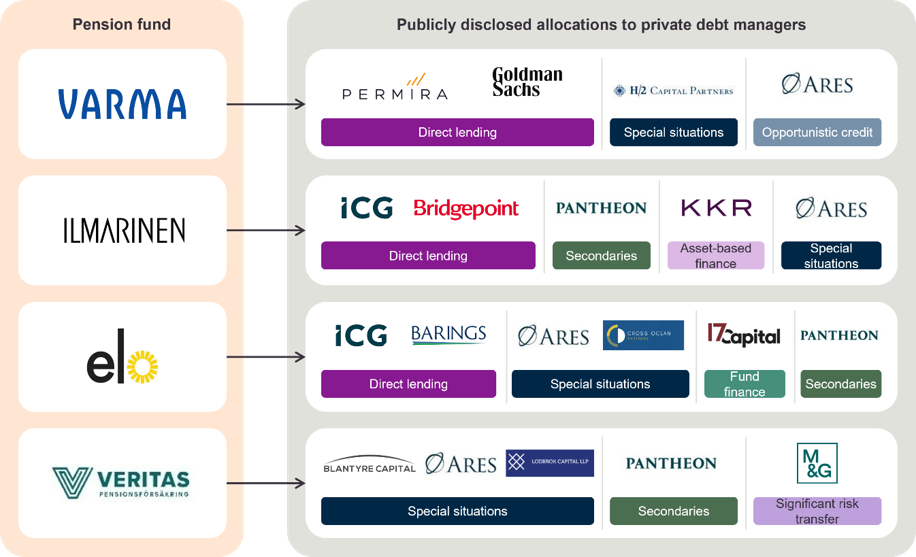
Finland’s pension providers have long been investors in private credit across a range of strategies, including direct lending, distressed debt, special situations and secondaries, with a particular appetite for opportunistic and complex credit.
Figure 6 – Examples of pension insurers’ private credit manager relationships by strategy
Source: Companies' reports and press releases.
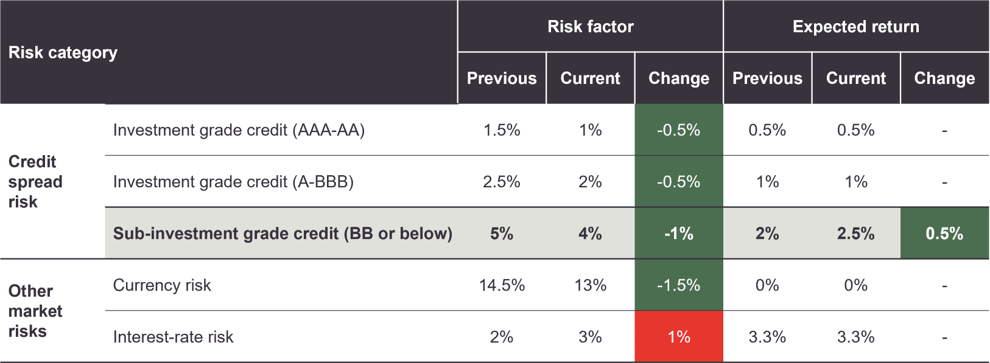
The reform further supports investment in these strategies by improving their capital treatment through a reduction in the prescribed risk factors. This is particularly relevant for distressed debt, mezzanine and special situations strategies, which can combine conventional credit exposure with equity-like instruments, such as warrants, convertibles or equity acquired through restructurings, meaning both credit and equity risk categories can apply.
For most private credit strategies, the most relevant risk module is credit spread risk. Crucially for private credit, credit instruments do not need to be externally rated. Similarly to Solvency II, the pension insurance companies can rely on their own internal assessment and unrated credit is not necessarily penalised.
Figure 7 – Changes to solvency risk parameters relevant to private credit
Source: Macfarlanes' analysis of Finnish Government publications.
Other considerations when fundraising from Finnish pension providers
Investment approach and fund terms
According to local partners, Finnish pension investors typically look for larger strategic partnerships with significant co-investment activity, estimated to account for over a quarter of Varma's and Ilmarinen's private markets portfolios. Long-term GP relationships are also important, with a preference for established managers and repeat commitments across fund vintages. Investors typically favour whole-fund carried interest structures (i.e. European waterfalls) and seek escrow and clawback protections for funds with American waterfalls.
Co-operation with other Nordic investors
Finnish pension insurers may also access private markets through collaborative investment structures that aggregate commitments and strengthen negotiating power. These investment clubs are well established in Denmark but also extend to institutional investors across the wider Nordic region. For example, Elo participates in Advantage Investment Partners' Nordic Investment Club, which brings together institutional investors to negotiate more favourable fees, co-investment opportunities and governance rights.
Fund governance
LPAC participation is an established practice among Nordic pension investors, particularly in the public sector. Keva reported holding LPAC seats across 98 private equity funds in 2025, with representation in almost all its largest fund investments. Similar practices are seen among Sweden’s AP funds.
Reporting requirements
Given the look-through requirements under Finland's solvency framework, pension insurers may request detailed quarterly reporting on a fund's underlying investments through side letter arrangements. This allows them to assess the fund's underlying risks for solvency capital calculations, serving a similar purpose to the Tripartite Template (TPT) used by Solvency II insurers.
Marketing requirements
Managers must notify FIN-FSA within two weeks of starting pre-marketing and ensure that materials provided to prospective investors comply with pre-marketing restrictions. Reverse solicitation is possible where records demonstrate that the investor initiated contact. However, subscriptions to the relevant funds within 18 months of the start of pre-marketing in Finland are deemed to result from marketing, regardless of whether the investor was directly targeted. ESG disclosures and sustainability considerations should also be addressed as part of fundraising preparations.
Key takeaways
Finland’s reforms signal a clear push towards greater investment risk-taking, with pension providers already adjusting their portfolios accordingly.
The reform reduces risk factors across a range of asset classes and recognises the higher return potential of unlisted equities and sub-investment-grade debt.
Finnish pension insurers are already sophisticated international LPs, known for large commitments, co-investment activity and long-term GP relationships. The reform is not expected to transform how they engage with private capital managers, but gives them greater headroom to pursue higher returns.
This note was prepared by our Investor Intelligence team, who provide holistic advice on how to shape products, terms, structures and marketing strategies to support fundraising efforts and fund-level transactions and deals.
For more details on fundraising in Finland and other Nordic regions, please contact our Investor Intelligence team.
Footnotes
- As of year-end 2025
- Borrowing must be through a subsidiary and is permitted for EEA real estate, subject to aggregate limits of 10% of the pension insurer's total investments and 50% of its net real estate investments.
- Finnish Parliament, Pension reform committee report (StVM 5/2026), 2026.
- Public Plans Data, National Data, 2025.
- Pension Protection Fund, The Purple Book, 2025.
Authors


Related topics
Like what you are reading?
Stay up to date with our latest insights, events and updates – direct to your inbox.
How can we help you?
Browse our people by name, team or area of focus to find the expert that you need.